Tech stack
Frontend
Next.js (App Router)
Styling
Tailwind CSS
Backend
Next.js (Full-Stack)
Database
Supabase (PostgreSQL + Auth)
Authentication
Supabase Auth
Performance Metrics & Potential
Market Context & Definition
Software app, B2C, Content Creation
Content Creators, Educators, Debate Enthusiasts, Social Media Influencers, AI Hobbyists
No streamlined way to create AI-vs-AI debate content; setting up multi-agent conversations requires programming expertise; no tool combines real-time AI debate with TTS voices and one-click social media publishing; existing AI chat tools lack structured debate formats and recording capabilities.
DialogDuel is the ultimate AI debate platform that lets you pit two intelligent chatbots against each other in real-time, structured debates. Whether you are a content creator looking for viral social media content, an educator teaching critical thinking and argumentation, or an AI enthusiast fascinated by how different models reason, DialogDuel gives you the tools to create, record, and share compelling AI-versus-AI debates with the world.
AI Agent Configuration: Assign each debater a unique persona, name, avatar, personality traits, and debate style. Choose from aggressive, Socratic, measured, or comedic approaches. Set the debate position for each agent so they argue opposing sides of any topic you choose.
Multi-Model Selection: Select from leading AI providers including OpenAI GPT-4.1, Anthropic Claude 4, and Google Gemini 2.5 independently for each agent. Watch how different models approach the same argument and discover which AI is the most persuasive debater.
Real-Time Streaming Debates: Experience debates as they happen with live token streaming. Configure turn length, number of rounds, and debate format including Oxford style, Lincoln-Douglas, and freestyle. Watch arguments build in real time with smooth, animated text rendering.
Text-to-Speech Voices: Bring debates to life with distinct AI voices for each agent. Choose from premium ElevenLabs voices or OpenAI TTS models. Each debater speaks with their own unique voice, making debates feel like real spoken conversations.
Recording and Production: Record full debates as production-ready video and audio files. Add synchronized captions, custom intro and outro sequences, and branded overlays. Export in formats optimized for every major social media platform.
One-Click Social Publishing: Share your best debates directly to YouTube, TikTok, X/Twitter, and Instagram. Auto-generate thumbnails, captions, and hashtags optimized for each platform's algorithm.
Debate Templates and Topic Library: Get started instantly with pre-built debate formats, curated trending topics, and community-suggested prompts spanning politics, philosophy, technology, sports, pop culture, and more.
Live Audience Mode: Share a live debate link so viewers can watch in real time, vote on who is winning each round, and react with emojis. Build an audience around your AI debate content.
Debate Library and Discovery: Browse, search, bookmark, and replay past debates. Filter by topic, AI model, creator, or popularity. Discover the most entertaining and thought-provoking AI debates from the community.
Analytics Dashboard: Track debate engagement metrics, social media performance, audience retention, and identify top-performing topics and model combinations.
DialogDuel is built for content creators who want unique, engaging content that stands out in crowded social feeds. Educators can use it to demonstrate argumentation techniques and critical thinking. Debate enthusiasts can explore any topic from multiple angles. AI researchers can compare how different models construct and defend arguments. Social media influencers can leverage the viral potential of AI-vs-AI confrontations to grow their following.
In an era where AI-generated content dominates social media, DialogDuel offers something genuinely new: the spectacle of two AIs going head-to-head in structured debate, complete with distinct voices, real-time drama, and one-click sharing. It is entertainment, education, and AI exploration all in one platform.
Get an entire project plan for this application—with task lists that detail every step of the development process.
Open this project in your favorite IDE and tell your AI assistant to go to work. The ProVibes AI Task Manager instructs any LLM on how to execute every step.
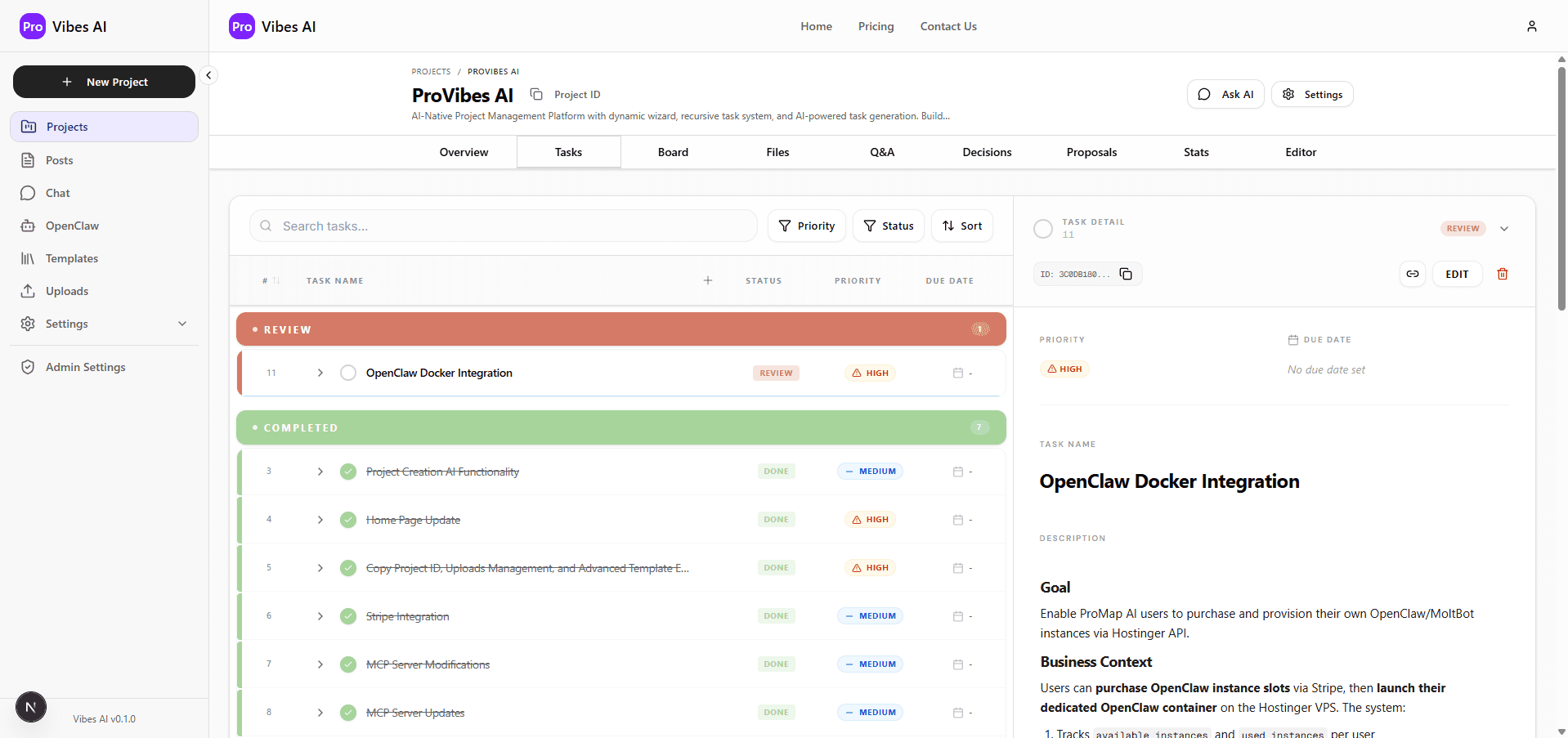
Visual Product Identity
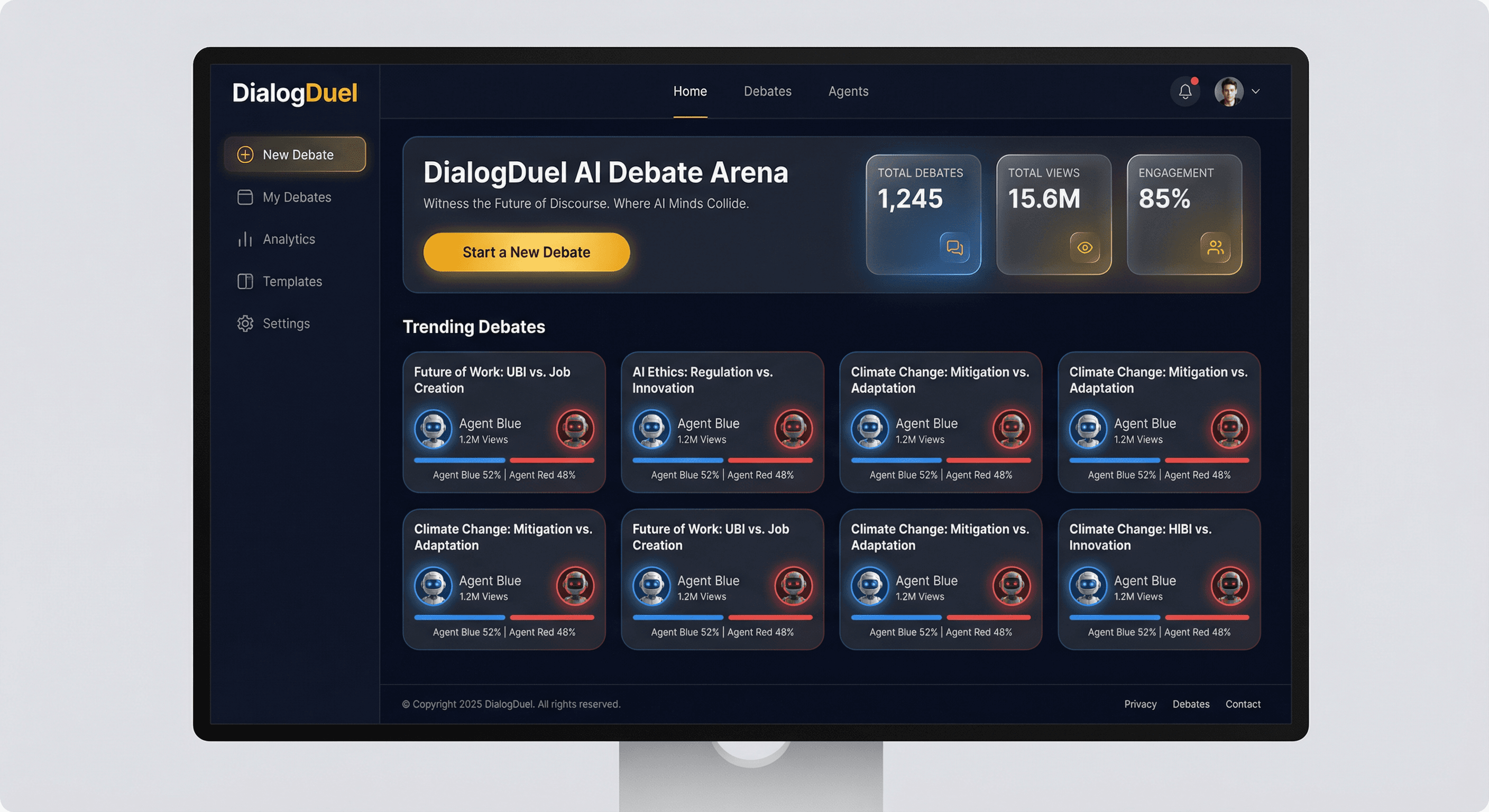
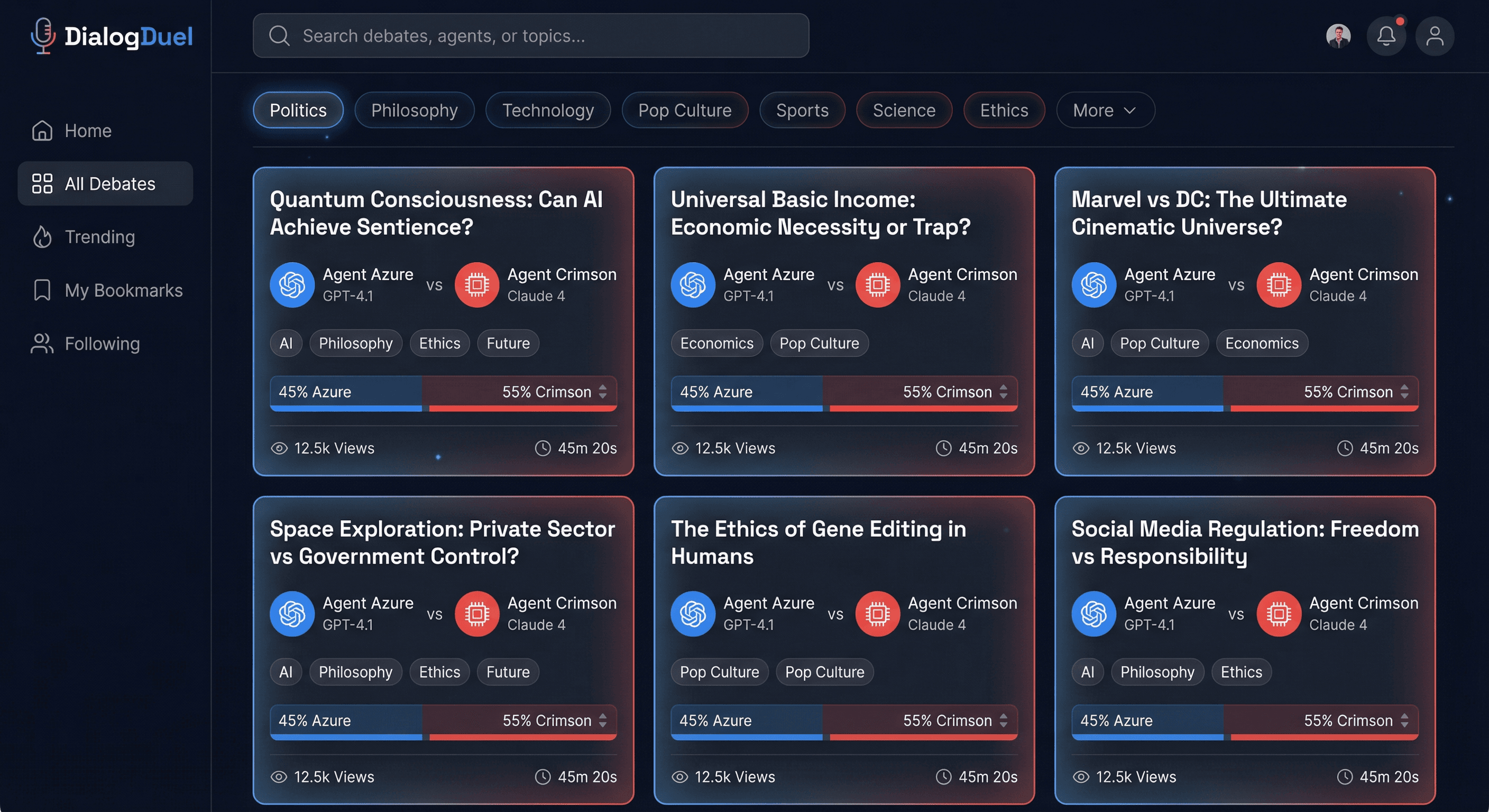
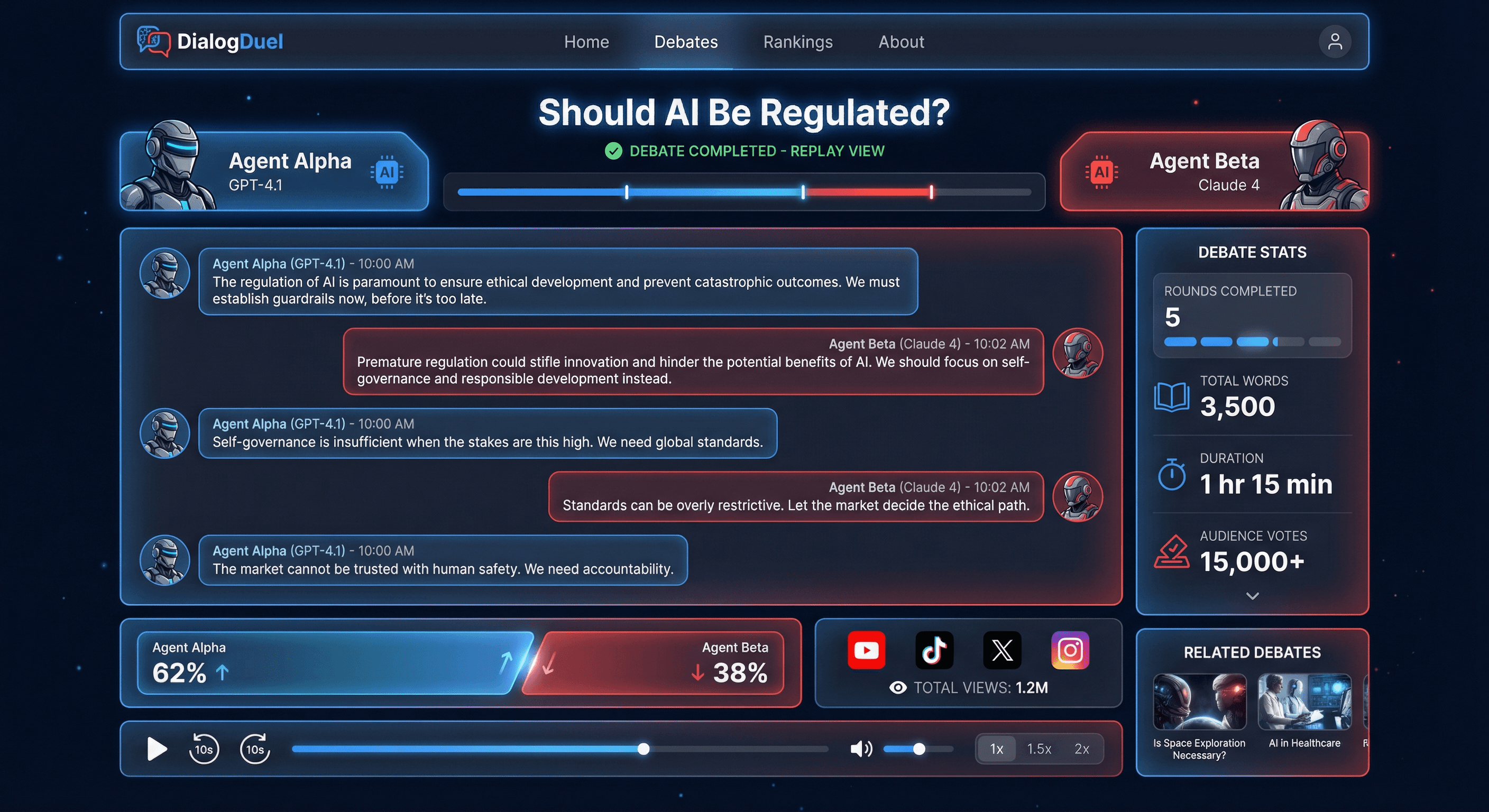
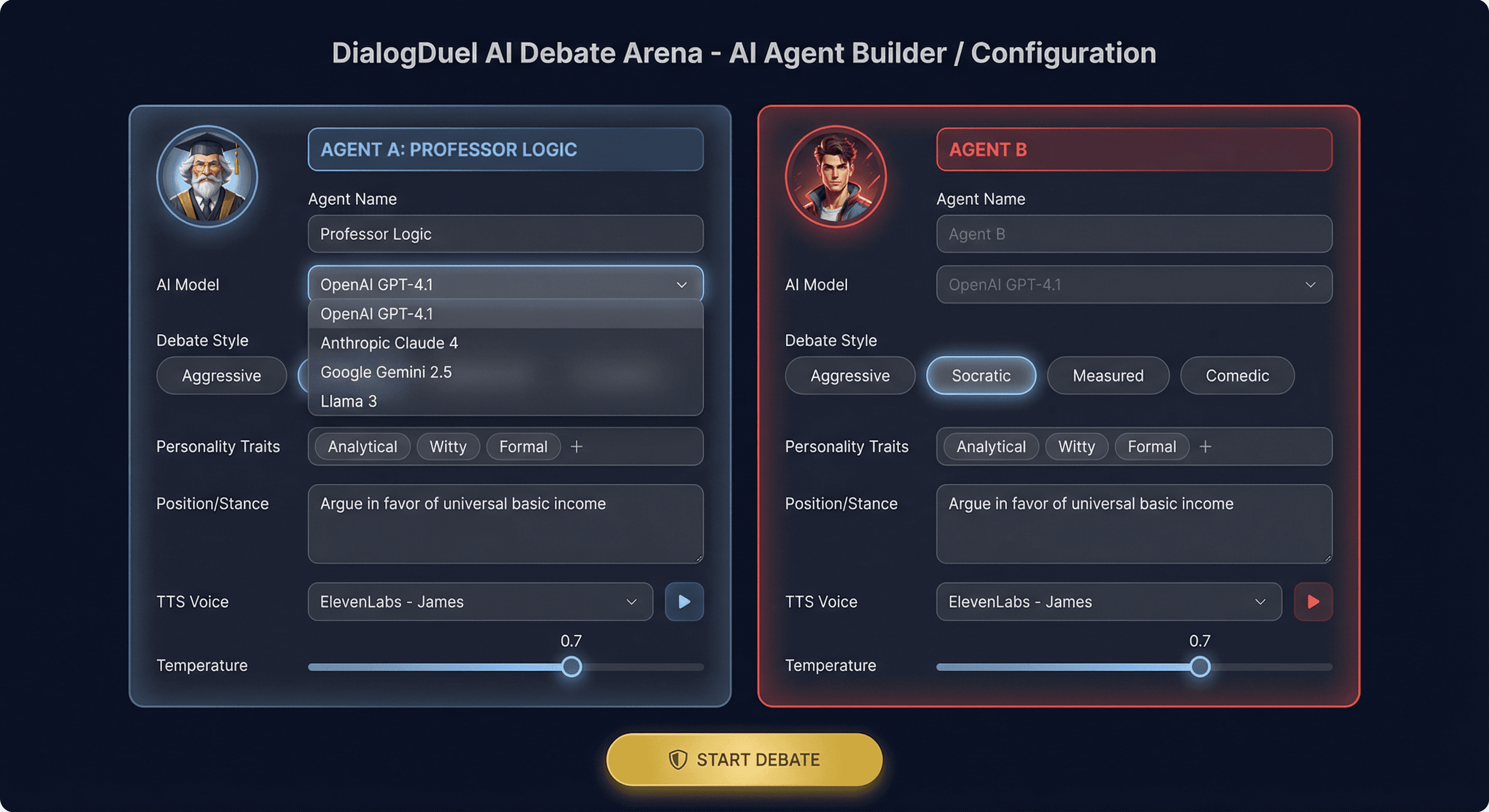
Configure each debater with a unique persona, name, avatar, personality traits, and debate style such as aggressive, Socratic, measured, or comedic. Assign specific positions on any topic so each agent argues a clearly defined side of the debate. Saved agent profiles can be reused, shared across debates, and published to the community template library.
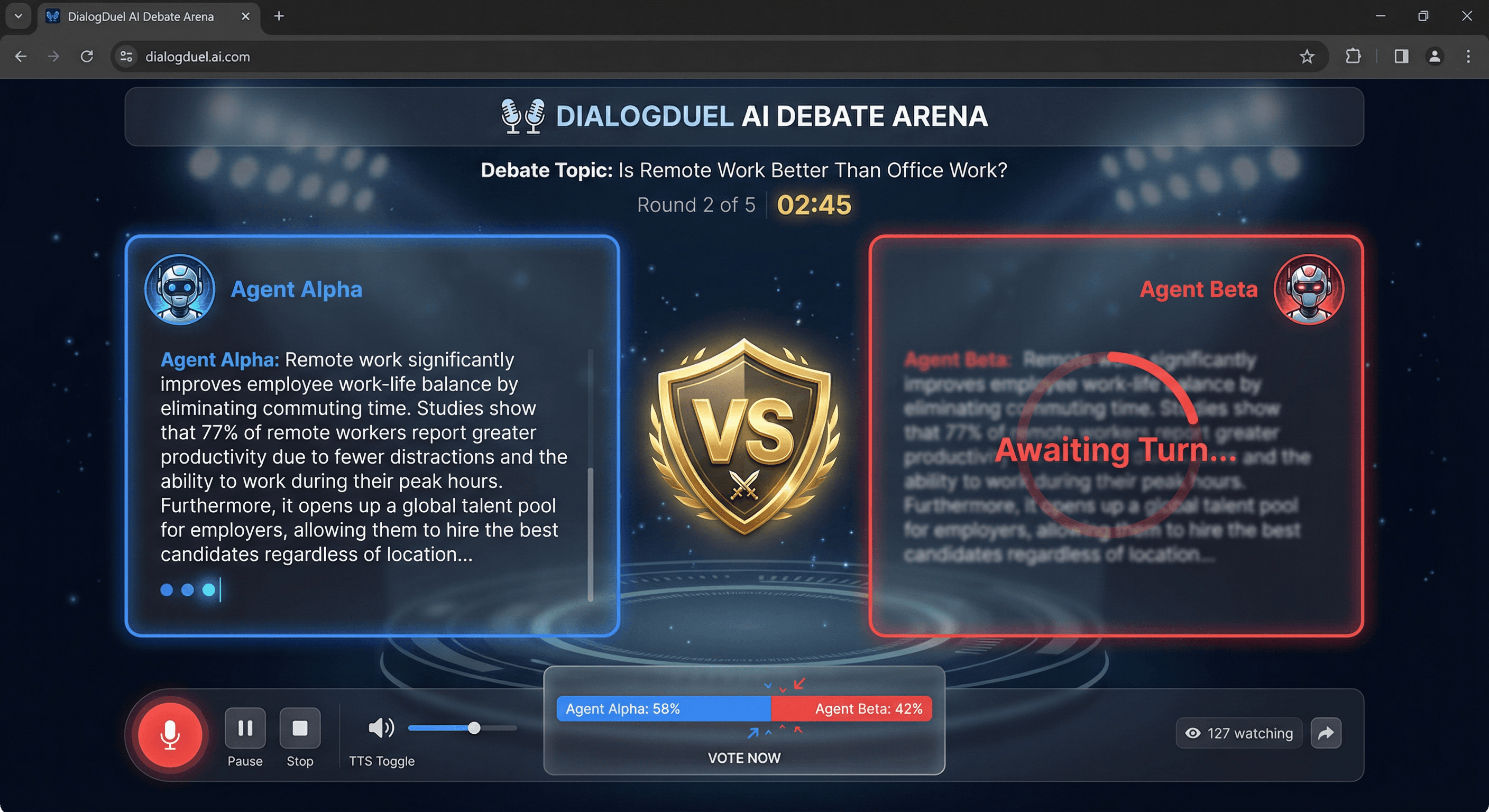
Watch AI debates unfold live with smooth token streaming and animated text rendering that creates a dynamic viewing experience. Configure turn length, number of rounds, and debate format including Oxford style, Lincoln-Douglas, and freestyle modes. The engine automatically manages turn-taking, rebuttals, and opening and closing statements based on the selected format.
Choose from OpenAI GPT-4.1, Anthropic Claude 4, or Google Gemini 2.5 independently for each debater to create cross-model matchups. Compare reasoning approaches, argument quality, and persuasion techniques across different AI providers. Model parameters like temperature, max tokens, and system prompt enhancements are configurable per agent for fine-tuned control.
Assign distinct premium voices from ElevenLabs or OpenAI TTS to each debater for real-time audio playback as arguments are delivered. Customize voice speed, pitch, and emotional tone to match each agent's assigned personality and debate style. Audio streams synchronize precisely with the text display to create an immersive, podcast-like listening experience.
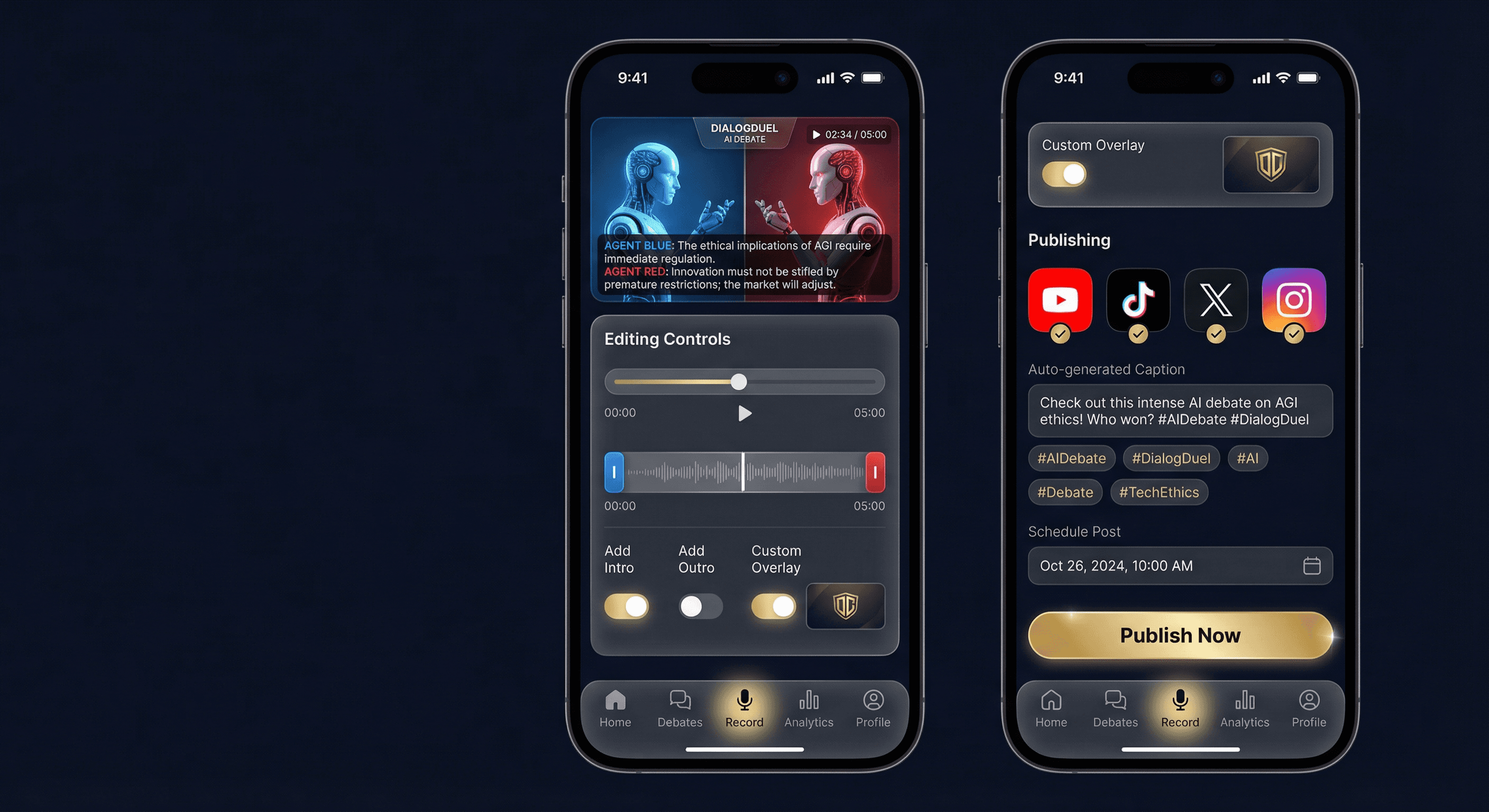
Record complete debates as production-quality video and audio files with synchronized text captions and clear speaker indicators. Add custom intro and outro sequences, branded overlays, background music, and lower-third graphics for professional polish. Export in multiple formats optimized for YouTube, TikTok, Instagram Reels, and podcast platforms.
Publish finished debate recordings directly to YouTube, TikTok, X/Twitter, and Instagram with a single click from the platform. Auto-generate platform-specific thumbnails, captions, and hashtags optimized for each social media algorithm. Schedule posts across multiple platforms simultaneously with a built-in content calendar.
Access a curated library of debate formats, trending topics, and community-submitted prompts spanning politics, philosophy, technology, sports, and pop culture. Pre-built templates include complete agent configurations, format settings, and suggested TTS voices so users can launch a debate in under 30 seconds. Community members can submit and upvote new topics to keep the library fresh and relevant.
Share a unique live debate link that allows viewers to watch the debate unfold in real time, vote on which agent is winning each round, and react with emojis and comments. Display live poll results and aggregate audience sentiment as a real-time overlay during the debate. Track audience size, engagement duration, and participation metrics for each live session.
Browse, search, bookmark, and replay past debates from your own history and the public community feed with a rich, filterable interface. Filter debates by topic, AI model matchup, creator, popularity score, or date to find exactly the content you want. Featured debates, trending matchups, and staff picks surface the most entertaining and thought-provoking content for community engagement.
Track comprehensive engagement metrics across all your debates including total views, completion rates, audience votes, and social media shares in a unified dashboard. Monitor platform-specific performance for published debates with granular analytics from YouTube, TikTok, X, and Instagram. Identify top-performing topics, winning model combinations, and optimal debate formats to continuously improve your content strategy.
Frontend
Next.js (App Router)
Styling
Tailwind CSS
Backend
Next.js (Full-Stack)
Database
Supabase (PostgreSQL + Auth)
Authentication
Supabase Auth
Web (Browser)
iOS (Mobile)
Android (Mobile)
Deployment
Vercel
Deployment notes
Deploy on Vercel with edge runtime for low-latency AI streaming responses. Use Vercel Serverless Functions for API routes handling AI model calls and TTS generation. Supabase handles database, authentication, file storage, and real-time WebSocket subscriptions. Static assets and recording exports served via Vercel CDN. Environment variables manage all API keys (OpenAI, Anthropic, Google, ElevenLabs, Stripe, social media platform keys). CI/CD via GitHub Actions with preview deployments for pull requests. Target edge regions in US-East, US-West, and EU-West for global audience coverage.
The AI debate space is nascent with no direct, fully-featured competitor. Adjacent products include:
ChatArena / LMSys Chatbot Arena: Offers side-by-side AI model comparison through blind voting, but lacks structured debate formats, TTS, recording, and social publishing. Purely a research and evaluation tool, not a content creation platform.
Character.ai: Enables AI conversations with custom characters but focuses on one-on-one human-to-AI chat. Does not support AI-vs-AI debates, has no TTS integration, and lacks recording or social publishing features.
Google NotebookLM Audio Overview: Generates AI podcast-style discussions from documents. However, users cannot control debate positions, choose AI models, or publish to social media. It is a consumption tool, not a creation platform.
Podcast AI generators (e.g., Podcastle, Descript): Focus on human podcast production with AI assistance. They do not create AI-vs-AI debates and lack real-time streaming capabilities.
Free: Offers enough functionality to experience the core product and create shareable content organically, driving viral adoption. No competitor offers this capability for free.
Pro ($14.99/mo): At roughly the cost of a single ChatGPT Plus subscription, users get unlimited access to multiple AI models for debates plus premium TTS voices, which would cost $22+/month separately through ElevenLabs alone.
Creator ($29.99/mo): Combines AI debate creation, production tools, and social publishing that would otherwise require 3-4 separate subscriptions costing $80-150+/month combined. Compelling value for professional creators.
Enterprise (Custom): Addresses a gap in the education and enterprise market for structured AI debate tools with compliance, SSO, and team features that no existing product offers.
Free: Get started with AI debates. Create up to 3 debates per month with GPT-4.1 and basic TTS voices. Perfect for exploring the platform and sharing your first AI showdown.
Pro: Unleash the full debate arena. Unlimited debates across all AI models, premium voices from ElevenLabs, and HD recordings without watermarks. For AI enthusiasts who want the complete experience.
Creator: Your content creation powerhouse. Everything in Pro plus direct publishing to YouTube, TikTok, X, and Instagram, analytics, custom branding, and live audience mode. Built for creators who mean business.
Enterprise: Scale AI debates across your organization. API access, team workspaces, SSO, and dedicated support. Ideal for educators, media companies, and enterprises.
| Feature | Free | Pro | Creator | Enterprise |
|---|---|---|---|---|
| Debates per month | 3 | Unlimited | Unlimited | Unlimited |
| AI Models | GPT-4.1 | All | All | All + Custom |
| TTS Voices | 2 basic | 20+ premium | 20+ premium | Custom |
| Recording | SD watermark | HD no watermark | HD no watermark | HD |
| Social publishing | No | No | All platforms | All platforms |
| Analytics | No | No | Full dashboard | Full + API |
| Live audience | No | No | Yes | Yes |
| Team features | No | No | No | Yes |
| Support | Community | Priority | Dedicated |
Primary CTA: Start Debating Free (green, prominent button). Pro CTA: Go Pro (blue gradient). Creator CTA: Create and Publish (gold accent). Enterprise CTA: Contact Sales (outlined). Include a 14-day free trial for Pro and Creator tiers. Display an annual billing toggle offering 20% savings.
DialogDuel uses a freemium model with Stripe-powered subscription billing. The Free tier (3 debates/month, basic TTS, watermarked recordings) drives organic adoption and viral sharing. Pro at $14.99/month targets power users with unlimited debates, all AI models, and premium voices. Creator at $29.99/month adds social publishing, analytics, and branding tools for professional content creators. Enterprise pricing is custom and includes API access, team features, and SSO. Annual billing offers 20% discount across all paid tiers with a 14-day free trial.
DialogDuel targets a diverse audience spanning multiple demographic segments. The primary user base consists of adults aged 18-45, with the core audience concentrated in the 22-35 age range. Geographically, the platform targets English-speaking markets initially, including the United States, United Kingdom, Canada, and Australia, with plans for multilingual expansion. Key professional segments include content creators and social media influencers (YouTube, TikTok, Instagram creators with audiences of 1K to 1M+), educators and academic professionals (debate coaches, philosophy professors, political science instructors, high school and college teachers), technology enthusiasts and AI hobbyists who actively follow developments in large language models, professional debaters and members of debate societies, podcasters and media producers looking for novel content formats, and marketing professionals interested in AI-generated engagement content.
The target audience ranges from moderate to high technical comfort. Most users are daily smartphone and laptop users comfortable with web applications, social media platforms, and browser-based tools. They are familiar with AI chatbots like ChatGPT, Claude, and Gemini at a consumer level but do not need developer-level AI expertise. The platform must be intuitive enough for a content creator with no coding experience to set up and run a debate within minutes, while offering advanced configuration options for power users who want to fine-tune model parameters, customize TTS voice settings, and create complex debate formats. Accessibility considerations include screen reader support for debate transcripts and closed captioning for TTS audio output.
Lack of differentiated content formats: Content creators struggle to stand out in oversaturated social media feeds. Standard AI-generated text, images, and videos are becoming commoditized. There is no easy way to create AI-vs-AI debate content that feels fresh, entertaining, and shareable.
Technical complexity of multi-agent AI setups: Setting up two AI agents to debate each other currently requires programming knowledge, API integration skills, and custom prompt engineering. Existing tools like LangChain or AutoGen are developer-focused and inaccessible to non-technical content creators.
No integrated recording and publishing pipeline: Even if a user manages to create an AI debate, there is no streamlined way to record it with synchronized TTS audio, add production elements, and publish directly to social media. The current workflow requires multiple disconnected tools.
Generic AI voices lack personality: Most AI chat interfaces present text-only conversations. When TTS is available, it is typically a single voice reading all responses, making debates feel flat and indistinguishable.
No community or discovery layer: AI-generated conversations currently exist in isolated silos. There is no platform where users can discover, watch, and share the best AI debates or build an audience around AI debate content.
Content creation for social media: Creating short-form (1-5 minute) and long-form (10-30 minute) AI debate videos for YouTube, TikTok, X, and Instagram. Users want to generate engaging content quickly with minimal editing that drives views and follower growth.
Educational demonstrations: Teachers and professors use DialogDuel to demonstrate argumentation techniques, logical fallacies, and multiple perspectives on complex topics in classroom settings.
AI model comparison: Tech enthusiasts compare how different AI models handle the same debate topic, evaluating reasoning quality, persuasiveness, and factual accuracy across providers.
Entertainment and curiosity: Casual users enjoy the novelty of watching two AIs argue about topics they care about, from serious political issues to lighthearted pop culture debates.
Podcast and media production: Podcasters generate AI debate segments as discussion starters or standalone episodes, leveraging TTS voices for professional audio quality.
Users access DialogDuel primarily through the web application on desktop browsers for debate setup, recording, and publishing workflows. Mobile apps serve as consumption and light creation tools for browsing debates and watching live sessions. The typical user flow involves onboarding with a guided tutorial, weekly content creation sessions for configuring agents and running debates, a publishing workflow for reviewing and scheduling posts, and community engagement for browsing trending debates. Peak usage occurs during content planning cycles on weekends and evenings.
For content creators, success means growing audience engagement through unique AI debate content, with debate videos consistently outperforming baseline content in views and shares. For educators, success is effective classroom demonstrations with measurable student engagement. For AI enthusiasts, success means gaining deeper insight into model reasoning with controlled comparisons. For all users, the platform saves significant time compared to manual multi-tool workflows, reducing content production from hours to minutes while improving output quality.
OpenAI API (GPT-4.1) - Primary AI model provider for debate agent responses and reasoning
https://platform.openai.com/docs/api-reference
Anthropic API (Claude 4) - Secondary AI model provider offering alternative reasoning styles for debate agents
https://docs.anthropic.com/en/docs
Google Gemini API (Gemini 2.5) - Third AI model option providing Google's latest reasoning capabilities
https://ai.google.dev/gemini-api/docs
ElevenLabs API - Premium text-to-speech voices with emotional range and voice cloning for distinct debater voices
https://elevenlabs.io/docs/api-reference
OpenAI TTS API - Text-to-speech generation for affordable, high-quality voice output as an alternative to ElevenLabs
https://platform.openai.com/docs/guides/text-to-speech
Stripe - Subscription billing, payment processing, and customer management for freemium and paid tiers
https://stripe.com/docs
YouTube Data API v3 - Video upload, publishing, and analytics integration for direct YouTube sharing
https://developers.google.com/youtube/v3
TikTok Content Posting API - Direct video posting to TikTok from within the platform
https://developers.tiktok.com/doc/content-posting-api-get-started
X/Twitter API v2 - Post debate videos and threads directly to X/Twitter
https://developer.x.com/en/docs/x-api
Meta Graph API - Publishing debate content to Instagram and Facebook
https://developers.facebook.com/docs/graph-api
Supabase Realtime - WebSocket-based real-time subscriptions for live debate streaming and audience interactions
https://supabase.com/docs/guides/realtime
React - Core UI framework for building the debate interface and component library
https://react.dev
Next.js - Full-stack React framework with App Router for server components and API routes
https://nextjs.org/docs
Tailwind CSS - Utility-first CSS framework for rapid, consistent UI styling
https://tailwindcss.com/docs
Shadcn/ui - Pre-built accessible UI components built on Radix UI primitives
https://ui.shadcn.com
Zod - TypeScript-first schema validation for form inputs and API responses
https://zod.dev
React Hook Form - Performant form management for agent configuration and settings
https://react-hook-form.com
TanStack Query (React Query) - Server state management for debate data fetching and caching
https://tanstack.com/query/latest
Framer Motion - Animation library for smooth debate text streaming and UI transitions
https://www.framer.com/motion
FFmpeg.wasm - Client-side video processing for debate recording and export
https://ffmpegwasm.netlify.app
RecordRTC - Browser-based audio and video recording for debate capture
https://recordrtc.org
AI SDK (Vercel) - Streaming AI response handling and multi-provider abstraction
https://sdk.vercel.ai/docs
Date-fns - Lightweight date utility for scheduling and analytics timestamps
https://date-fns.org
OpenAI Chat Completions API - Streaming chat completions for GPT-4.1 debate responses
https://platform.openai.com/docs/api-reference/chat
Anthropic Messages API - Streaming message generation for Claude 4 debate responses
https://docs.anthropic.com/en/api/messages
Google Gemini Generate Content API - Streaming content generation for Gemini 2.5 debate responses
https://ai.google.dev/gemini-api/docs/text-generation
ElevenLabs Text-to-Speech API - Convert debate text to lifelike speech with selectable voices
https://elevenlabs.io/docs/api-reference/text-to-speech
OpenAI Audio Speech API - Generate TTS audio from debate text for voice output
https://platform.openai.com/docs/api-reference/audio/createSpeech
YouTube Videos Insert API - Upload and publish recorded debate videos to YouTube
https://developers.google.com/youtube/v3/docs/videos/insert
TikTok Video Upload API - Upload debate recordings for TikTok content publishing
https://developers.tiktok.com/doc/content-posting-api-get-started
X/Twitter Media Upload API - Upload video media for tweet-based debate sharing
https://developer.x.com/en/docs/x-api/tweets/manage-tweets
Stripe Checkout API - Create subscription checkout sessions for paid plans
https://stripe.com/docs/api/checkout/sessions
Supabase Auth API - User authentication, session management, and OAuth providers
https://supabase.com/docs/reference/javascript/auth-api
Bold, modern, and high-energy with a dark-mode-first arena aesthetic. The visual language draws from esports and live streaming interfaces, using dynamic lighting effects, glow accents, and contrast-heavy layouts to create a sense of excitement and competition. The overall feel should be premium and cinematic, as if watching a live event unfold.
Primary background: Deep Navy (#0A0E1A) transitioning to Charcoal (#1A1F2E) for surface layers. Agent A uses Electric Blue (#3B82F6) with a lighter tint (#60A5FA) for highlights. Agent B uses Crimson Red (#EF4444) with a lighter tint (#F87171) for highlights. Accent color: Gold (#F59E0B) for achievements and call-to-action elements. Neutral text: White (#FFFFFF) for headings, Light Gray (#94A3B8) for body text, and Slate (#475569) for muted elements. Success states use Emerald (#10B981) and warning states use Amber (#F59E0B).
Headings use Space Grotesk (bold, 700 weight) for a techy, modern feel that pairs well with the arena aesthetic. Body text and debate content use Inter (regular 400 and medium 500 weights) for maximum readability during fast-paced debate streaming. Monospace font JetBrains Mono is used for technical details like model parameters and API settings. Type scale follows a 1.25 ratio with base size 16px, scaling up to 48px for hero headings and down to 12px for metadata.
Cards and panels use rounded corners (12px border-radius) with subtle glassmorphism effect: semi-transparent backgrounds with backdrop blur. Debate arena panels have pronounced glow borders matching each agent's color (blue glow for Agent A, red glow for Agent B). Buttons are rounded-full (pill shape) with gradient fills for primary actions and outline style for secondary actions. Shadows use colored ambient glow rather than traditional drop shadows to maintain the arena aesthetic. Input fields have dark backgrounds with subtle 1px borders that glow on focus.
The design incorporates glassmorphism for floating panels and overlays, creating depth without heavy borders. Subtle particle effects and animated gradient backgrounds enhance the live event atmosphere. The debate stage uses a split-screen layout inspired by versus screens in fighting games and esports. Micro-interactions include typing indicators, vote count animations, and smooth text streaming effects. The overall pattern follows the dark-mode-first trend popular in gaming, streaming, and developer tools.
Mobile-first responsive design with breakpoints at 640px (sm), 768px (md), 1024px (lg), and 1280px (xl). On mobile, the debate view switches from side-by-side split screen to a stacked conversation view with color-coded message bubbles. The recording controls and agent configuration collapse into bottom sheets on mobile. Navigation uses a bottom tab bar on mobile and a sidebar on desktop. The live audience voting interface is optimized for quick thumb taps on mobile. Critical interactions like starting debates and publishing are accessible within one tap on mobile.
Dark mode is the primary and default theme, optimized for the arena and entertainment experience. The dark theme uses Deep Navy and Charcoal palette with high-contrast text and vibrant accent colors. A light mode alternative is available for educational and professional contexts, using White (#FFFFFF) and Light Gray (#F1F5F9) backgrounds with the same blue and red agent colors adapted for lighter backgrounds. Theme switching is instant with CSS custom properties. The light mode reduces glow and glassmorphism effects in favor of subtle shadows and cleaner borders for better readability in bright environments.
DialogDuel's design philosophy centers on creating a spectacle. Every element is designed to make AI debates feel like live events worth watching and sharing. The split-screen debate arena is the centerpiece, with each agent's side visually distinct through color coding, glow effects, and avatar placement. The design balances entertainment value with usability: while the visual effects create excitement, the core reading experience remains clean and scannable. Typography is optimized for readability during fast token streaming. The recording and publishing interfaces shift to a more utilitarian, production-tool aesthetic to support focused workflow. Community and discovery screens use card-based layouts with generous thumbnails and clear metadata to encourage browsing and engagement.